The End of Minimum Production Costs: How Seedance 2.0 and Kling 3.0 Sparked a 1,000-Fold Surge in AI Live-Action Micro-Dramas
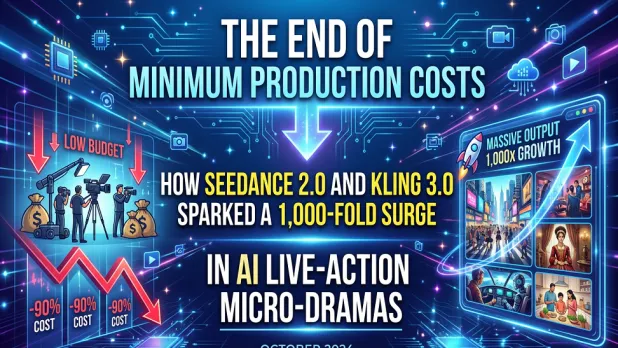
In early 2026, the tides of the vertical short drama industry completely shifted. The short-form entertainment market, which once relied heavily on massive live-action production crews, is experiencing an unprecedented phase of structural optimization. At the center of this transformation is the commercial launch of next-generation AI video models like ByteDance's Seedance 2.0 and Kuaishou's Kling 3.0, which have effectively eliminated the traditional minimum production cost floor for live-action mobile content.
The Radical Shift in Short Drama Production Economics
Data from industry trackers shows a stark economic reality. A traditional, live-action vertical short drama typically requires a budget of 400,000 to 500,000 yuan ($55,000 to $70,000 USD) and weeks of coordinated shooting across tightly packed physical sets. Equipment rentals, director fees, cast payroll, and location scouting historically created a rigid financial floor. If a series failed to gain immediate algorithmic traction on platforms like TikTok or Douyin, investors faced total capital loss.
Today, utilizing Seedance 2.0 or Kling 3.0, a highly consistent AI-assisted live-action drama costs between 120,000 and 150,000 yuan. When pushed into industrial batch-production pipelines, that cost can be aggressively compressed to less than 50,000 yuan per series. This represents an 80% to 90% reduction in upfront capital requirements. By eliminating the physical boundaries of filmmaking, generative AI has turned what was once a high-risk creative gamble into a calculated, data-driven software operation.
Architectural Breakthroughs: Visual Consistency and Temporal Anchor Tech
Overcoming the Flashing and Morphing Bottlenecks
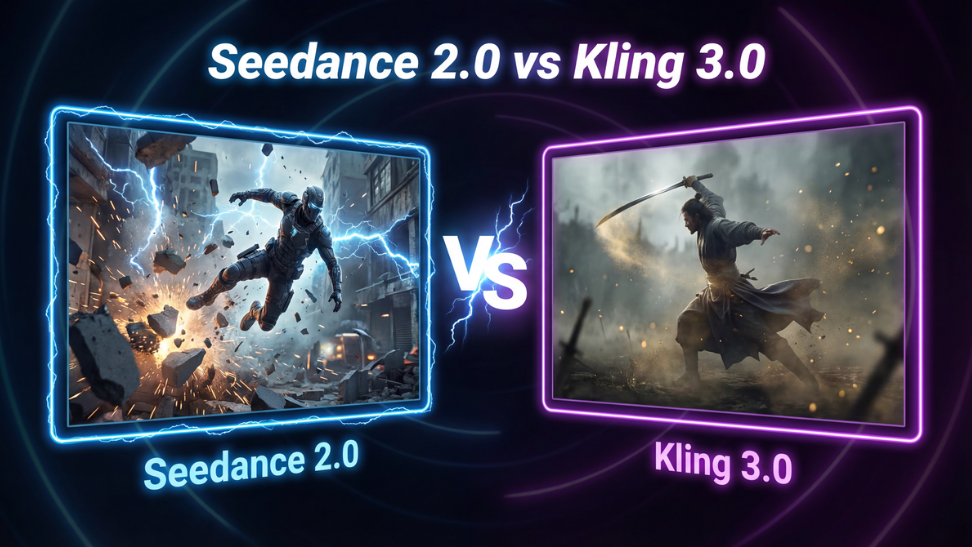
What makes the 2026 generation of AI video tools fundamentally different from earlier iterations is their mastery over temporal consistency and character fidelity. In 2024 and 2025, AI video tools were largely plagued by 'morphing'—where a character’s face, clothing, or surroundings would subtly shift between frames, destroying narrative immersion. Seedance 2.0 introduces an advanced Temporal Anchor technology that locks character meshes across multi-shot sequences.
Multi-Angle Lighting and Virtual Cinematography
Similarly, Kling 3.0 offers a revolutionary multi-angle lighting engine. Creators can now generate a digital actor and place them in diverse environments—from a rain-slicked neon street to a medieval castle—while maintaining exact facial geometry, shadow placement, and fabric textures. This level of control allows AI-generated live-action shorts to bypass the 'uncanny valley' and match the visual quality of mid-tier mobile cinematography. The software acts not just as a rendering engine, but as an automated director of photography, gaffer, and makeup artist combined into a single cloud-based interface.
The Rise of the 'AI Super-Individual' Creator
Redefining the Traditional Film Crew Hierarchy
Beyond cost, efficiency has soared exponentially. Traditional workflows that required full crews and days of post-production editing are now compressed up to five times over. The traditional film crew hierarchy—consisting of dozens of specialized roles—is being dismantled. In its place is the 'AI super-individual'—a single creative operator who commands an entire virtual production workflow from a single workstation.
With a well-trained pipeline consisting of an LLM for script generation, a localized voice-cloning tool, and a video model like Seedance 2.0, one person can write, direct, animate, and edit an entire 80-episode micro-drama within 72 hours. This hyper-acceleration has led to an explosion in market output, with over 10,000 AI-native titles hitting major distribution platforms every single month. Independent creators who were previously locked out of the market due to lack of funding are now competing directly with established production houses.
Monetization Obstacles in an Era of Content Saturation
The Dilution of Platform Revenue-Sharing Models
However, this thousand-fold surge in production capacity introduces intense monetization challenges. When volume increases exponentially, platform algorithm real estate becomes fiercely competitive. The sheer volume of content has led to intense user attention fragmentation. Because the cost of creation is so low, platforms are being flooded with derivative, formulaic content, causing ad-monetization yields per view to drop significantly.
Standard revenue-sharing models are being diluted as major platforms adjust their distribution algorithms to favor high user-retention scores over sheer volume. Production houses running automated AI 'content farms' are finding that while their costs are near zero, their return on investment is similarly flattening out. The rapid commoditization of the visual layer means that low-effort AI generation is no longer a guaranteed ticket to viral monetization.
The Return to Narrative Mastery as the Ultimate Moat
Industry veterans emphasize that while AI has democratized production access, the ultimate competitive edge has returned to the core narrative. When any creator can generate a visually stunning cinematic sequence for pennies, the script structure, emotional pacing, and deep understanding of human desires remain the final arbiters of audience retention. The true moat in 2026 is no longer the technology used to generate the video, but the human psychological insights embedded within the script.
As the industry matures, the winning strategy is evolving into a hybrid model. The most successful studios are employing human master-screenwriters to design complex emotional arcs and viral hooks, while using AI as an infrastructure layer to scale execution. By treating AI as an efficiency multiplier rather than a total creative replacement, forward-thinking entertainment companies are building sustainable, high-margin content portfolios that stand out in a saturated digital landscape.
Key Industry Takeaways
● Next-generation AI video tools like Seedance 2.0 and Kling 3.0 have slashed vertical short drama production costs by up to 80%.
● Production efficiency has multiplied fivefold, shifting the labor market toward 'AI super-individuals' who manage full virtual pipelines.
● Over 10,000 AI-native animated and live-action micro-dramas are now going live monthly, leading to high platform saturation.
● As visual generation commoditizes, the monetization bottleneck is shifting heavily back to script quality and story structure.
Related Recommendations