
From Doomscrolling to Story Addiction: Why Micro-Series Are Becoming the Antidote to Social Media Fatigue
Short-form serialized storytelling is emerging as a new entertainment layer built for fragmented attention — offering structure, emotional continuity, and a growing alternative to endless social media feeds.
Social media was designed to keep users engaged. But in practice, it often produces the opposite experience: fragmented attention, repetitive content loops, and what many users now describe as “endless scrolling with no payoff.”
This growing fatigue — often associated with terms like doomscrolling or “information overload” — is reshaping how audiences consume digital entertainment. Increasingly, users are not rejecting content itself, but the lack of narrative continuity within it.
In response, a new format has accelerated rapidly across global markets: micro-series, also known as micro-dramas or short-form serialized storytelling.
These are scripted series delivered in vertical, mobile-first episodes typically lasting one to three minutes. Designed for rapid consumption but structured around serialized narratives, micro-series combine the pacing of social video with the continuity of traditional television storytelling.
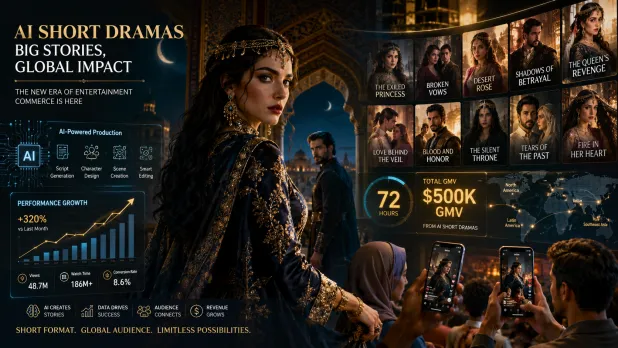
Platforms such as ReelShort, DramaBox, ShortMax, and DramaWave have scaled quickly across Asia and the United States, contributing to what is now a rapidly expanding short-form drama ecosystem. Industry forecasts suggest the global in-app revenue of micro-series content could reach $3.8 billion in 2025, with projections rising to $7.8 billion by 2026, reflecting strong momentum in monetization and user adoption.
While still an emerging category, micro-series are already appearing among the top-performing entertainment apps in major markets, including the United States, where short-drama platforms are increasingly visible in app store rankings and social media-driven discovery cycles.
From Infinite Feeds to Structured Storytelling
The rise of micro-series is closely tied to a structural shift in how digital platforms distribute content.
Traditional social media operates on an “infinite feed” model, where algorithms prioritize engagement signals over narrative continuity. Users are presented with an endless stream of disconnected content pieces — optimized for immediate interaction rather than long-term viewing progression.
Micro-series, by contrast, reintroduce structure.
Episodes are designed to be sequential, often ending in cliffhangers or unresolved emotional beats that encourage continued viewing. This creates a fundamentally different consumption pattern: instead of passive scrolling, users are drawn into progressive storytelling loops.
In this sense, micro-series can be understood as a hybrid format:
● Short enough for mobile attention spans
● Structured enough for narrative retention
● Emotional enough to sustain engagement over time
This combination is increasingly resonating with audiences experiencing fatigue from fragmented digital consumption.
Why Micro-Series Are Scaling Now
Several converging factors explain the rapid growth of micro-series platforms:
1. Mobile-first viewing behavior
Short-form video consumption has normalized vertical, episodic content. Micro-series build directly on this behavior, extending it from isolated clips into serialized storytelling.
2. Algorithmic distribution
Discovery is driven heavily by social platforms, where trailers and episode clips circulate widely, feeding demand into dedicated apps.
3. Low production barriers
Advances in digital production tools — including AI-assisted workflows — are reducing the time and cost required to produce serialized content, enabling faster iteration and experimentation.
4. Monetization flexibility
Platforms are experimenting with hybrid revenue models, including:
● micro-payments per episode
● subscription tiers
● advertising-supported viewing
● in-app purchases tied to story progression
This flexibility is particularly important in emerging markets, where user willingness to pay varies significantly.
The Return of Serialized Entertainment
Interestingly, micro-series also represent a partial return to older media logic.
Before algorithmic feeds dominated entertainment, serialized storytelling — from television dramas to soap operas — played a central role in audience engagement. The key difference today is distribution speed and production scale.
Instead of weekly episodes, micro-series deliver tightly compressed narrative units, often optimized for daily consumption. Instead of linear broadcast scheduling, they rely on algorithmic discovery and engagement-driven distribution.
This creates a new hybrid model:
the structure of television + the speed of social media + the optimization logic of AI systems
The Role of AI and Data-Driven Production
One of the defining characteristics of the modern micro-series ecosystem is the increasing use of data and AI in production workflows.
Studios and platforms are now able to:
● analyze viewer retention and drop-off points
● test multiple narrative variations
● adjust pacing and episode structure based on engagement signals
● localize content across languages using automated tools
In some cases, AI is also used to accelerate parts of the production pipeline, including editing support, subtitle generation, dubbing, and even preliminary content structuring.
This has enabled a new type of entertainment operation: fast-turnaround, data-responsive storytelling studios that operate closer to product development cycles than traditional film production.
Changing Audience Expectations
The popularity of micro-series also reflects a shift in audience psychology.
While social media feeds optimize for endless discovery, micro-series optimize for resolution over repetition.
Instead of asking users to scroll indefinitely, they encourage viewers to:
● follow a storyline
● anticipate outcomes
● emotionally invest in characters
● return for sequential progression
This creates what some analysts describe as “structured addiction” — not to isolated content, but to narrative continuity.
In this context, micro-series may not simply compete with social media platforms. They may serve as a complementary system that restores storytelling logic within fragmented digital environments.
A New Competitive Layer in Digital Entertainment
The rapid rise of micro-series is also reshaping competition across the media landscape.
Three ecosystems are now converging:
● Social platforms, which drive discovery and virality
● Dedicated micro-drama apps, which own serialized consumption
● Streaming platforms, which are increasingly exploring short-form formats
Each is attempting to capture a share of a growing audience segment that prefers mobile-native, episodic entertainment.
At the same time, creators are beginning to operate more like independent studios, using data insights, platform analytics, and AI tools to optimize storytelling and distribution strategies.
Conclusion: From Scrolling to Story Continuity
The growth of micro-series reflects more than just a new content trend. It signals a broader shift in how audiences interact with digital media.
As users become increasingly fatigued by infinite feeds and fragmented content environments, demand is rising for formats that offer continuity, progression, and emotional structure.
Micro-series are emerging as one of the first scalable responses to that demand — bridging the gap between social media behavior and traditional serialized storytelling.
Whether this format ultimately reshapes entertainment or becomes one layer within a larger ecosystem remains to be seen. But one thing is clear:
In a world built for endless scrolling, audiences are beginning to rediscover the value of stories that actually go somewhere.
Related Recommendations


Popular Articles


![[Dubbed Version] My Two-faced Boss](https://v.pinedrama.com/b1265344voduse1318177724/ac13a7675145403705097583385/94EBYl3j6hEA.webp!15491.webp)