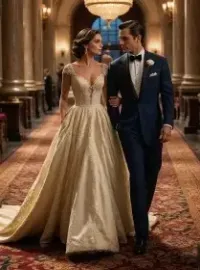
The car was black and quiet and smelled like leather and something I couldn't place — cedar, maybe, or the particular absence of anything cheap. Zane sat beside me with two inches of seat between us, which was two inches more than the space felt like.
I was watching the city slide past the window when I felt it.
His hands. The cool weight of metal at my throat. The soft, deliberate click of a clasp.
I went completely still.
In the glass of the window, I could see the reflection of it — a necklace, old gold, a single stone that caught the passing streetlights and held them. His hands withdrew. He said nothing. He straightened his cuffs and looked forward like he hadn't just done something that required a conversation.
I kept my eyes on the window.
'You always did have a talent,' I said, 'for making things feel like gifts when they're actually claims.'
A pause. The city moved.
'It was my mother's,' he said.
I said nothing. I did not touch the necklace. I did not take it off.
The car pulled up to the Met and the door opened and I stepped out into the cold October air with his late mother's gold at my throat, and I told myself it meant nothing, and I was almost convincing.
---
The gala was the kind of event that existed to remind people of the distance between themselves and everyone else in the room. Champagne that cost more than my first London paycheck. Flowers that had been flown in from somewhere with a better climate. Men in black tie who had never once worried about anything, and women who had learned to look like they hadn't either.
I had learned. Four years of London had taught me how to walk into a room like this and take up space without apology.
I worked the room the way I worked a deal — methodically, warmly, with the specific kind of attention that makes people feel like the most interesting person you've spoken to all evening. A fund manager from Boston who wanted to talk about emerging markets. A partner from a Singapore firm who had questions about the Torres Ventures model. Two men whose names I collected and whose cards I pocketed and whose interest I noted with the detached efficiency of someone who had learned that attention was a resource, not a compliment.
Zane watched me from across the room.
I knew because I could feel it. That particular quality of attention — steady, unblinking, the kind that doesn't shift when you move. I had felt it at the wedding. I felt it now, warmer and more focused, like something that had been patient for a very long time and was running out of patience.
I did not look at him. I laughed at something the Boston fund manager said and touched the necklace once, briefly, without meaning to, and moved on.
A woman beside me — someone's wife, someone's colleague, I had already forgotten — leaned in and said, quietly, 'He hasn't looked away from you all night.'
'Hasn't he,' I said.
'Do you know him?'
'Professionally,' I said, and smiled, and excused myself.
I found the corridor by accident. Or I told myself it was by accident. It was off the main hall, past a gallery of something ancient and lit from below, and it was quiet in the way that places are quiet when the noise is just far enough away to feel like another world. I stopped in front of a marble figure that had been standing in this building longer than either of us had been alive and breathed for the first time all evening.
I heard him behind me.
I didn't turn around. I watched his reflection appear in the dark glass of the display case — the suit, the set of his shoulders, the particular way he moved that I had spent four years trying to stop recognizing.
He stopped close. Too close. The kind of close that had a question in it.
'You're avoiding me,' he said.
'I've been working the room,' I said. 'That's what you brought me here for.'
'Katalina.'
I turned around.
He was right there. The corridor was narrow and the light was low and his eyes were doing the thing they did when he had run out of the particular patience he used in boardrooms — something rawer underneath, something that had been pressing against the surface all night.
He moved. One hand came up, flat against the stone wall beside my head. Not grabbing. Not forcing. Just — there. Closing the distance until there was no distance left.
I should have said something sharp. I had something sharp ready. I had been carrying it all evening like a card I could play.
He kissed me.
And I — God help me — kissed him back.
Four years collapsed into nothing. My hand was at his lapel and his other hand was at my jaw and it was furious and desperate and achingly familiar, the specific grammar of two people who had memorized each other and never fully unlearned it. He kissed me like he was apologizing for something he didn't have words for yet. I kissed him back like I was angry about it, which I was, which didn't seem to matter.
Then I pulled away.
I pressed the back of my hand to my mouth. Looked at him. His breathing was unsteady. His hand was still on the wall.
I straightened my dress. I did not touch the necklace.
'Don't,' I said quietly, and walked back into the light.
---
The champagne was a reason. The four years were the real reason. The hotel suite was on the forty-second floor and the city was spread out below us like something that had no opinion about any of this, and I had stopped pretending somewhere between the elevator and the door.
It was electric and furious and entirely mutual. We knew each other's bodies the way you know a language you learned young — fluently, without thinking, the muscle memory intact even when everything else had changed. I did not let myself be tender. I did not let myself linger in the afterward, in the particular warmth of his arm across my back and his breathing slowing beside me.
I lay still until it steadied. Until I was sure he was asleep.
Then I got up.
I dressed in the dark. I found my shoes. I took the necklace off and set it on the nightstand, and then I picked it back up, and then I set it down again. I left it.
I found the notepad on the desk — the kind hotels leave beside the phone — and I wrote four words. I counted out the bills from my wallet, more than enough, and set them on top of the note.
At the door, I looked back once.
He was asleep. One arm extended across the empty space where I had been, like a question he was asking in his sleep.
I left.
In the elevator, going down, I pressed my back against the mirrored wall and looked at my own reflection — dress slightly wrinkled, hair half-undone, throat bare where the necklace had been — and I told myself I felt nothing.
The note read: *For services rendered. You've gotten worse with age.*
It was a lie. That was the worst part. It was a complete and total lie, and I had left it on a nightstand forty-two floors up, and I was going to have to live with what that meant.