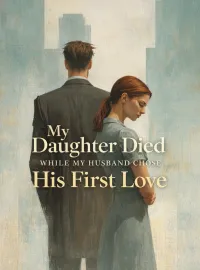
My Daughter Died While My Husband Chose His First Love Summary
Chapter 1 of My Daughter Died While My Husband Chose His First Love
The first of every month arrives with its own peculiar weight. I know this because I've been marking time this way for three years, ever since Lily's death carved a permanent before-and-after into my life. Today, I select the freshest white stem from Owen's shop—a simple carnation, nothing extravagant—and slip out before noon. Owen doesn't ask questions. He never has. That's why I've stayed.
I take the subway to Queens, then walk the remaining distance to the small cemetery. The morning air is crisp against my scarred cheek as I navigate the modest headstones. Lily's grave is unmarked by any Hughes family flourish—I paid for the simple marker myself, with wages from the flower shop. I kneel and place the white carnation against the cold stone, my fingers tracing the engraved letters of her name.
"Hello, Lily," I whisper. The words don't carry far. I never speak aloud to her here. The cemetery feels too exposed for that kind of intimacy. Instead, I sit back on my heels and let the silence stretch between us. The grass is damp beneath my jeans. I don't mind. I'd kneel on broken glass if it meant being this close to her.
Three years, and the pain hasn't dulled. It's transformed into something else—a constant, low-frequency hum that I've learned to live alongside. Like the scar on my face, it's simply there, a fact of my existence. I stay until my knees ache, then rise and brush off my clothes. I don't look back as I walk away. I know she's not really here. I know this is just a marker for a child who no longer exists in this world. But knowing doesn't make it easier to leave.
Back at the shop, I resume my routine. Owen's Flower Corner is small—just a storefront with a workroom behind it—but it's orderly. I sweep up fallen petals, count the register, arrange tomorrow's deliveries. My hands move through these motions with practiced efficiency while my mind remains elsewhere. This is how I survive: by compartmentalizing, by letting my body function while my soul remains elsewhere.
As I turn off the single overhead light, a memory fractures through the surface of my consciousness—December snow, my forehead striking frozen pavement, blood pooling red against white. Beckett's silhouette in the penthouse window above me, unmoving as I begged for our daughter's life. I stand in the dark shop until the memory passes, like a shadow moving across the sun. Then I lock the door and walk home.
Across the river in Manhattan, Beckett Hughes steps out of a sleek black car. He's here on business—some property acquisition in Brooklyn that requires his personal attention. As he walks toward the meeting location, his gaze passes over a small flower shop. Through the window, he glimpses a woman with a long scar running the length of her left jaw, her movements precise as she arranges blooms.
He stills. Something in his chest tightens. His expression shifts from the bored confidence of a man who owns half of New York to something darker, more focused. Recognition gives way to cold contempt. He still believes every lie, every fabrication that Elianna and his grandfather fed him. He still believes I hid his "illegitimate" daughter and fled like a thief in the night.
"Find out who owns that shop," he tells his assistant, a sharp-edged man who has worked for him for years. "And find out who that woman is."
His assistant nods, already making calls. Beckett's jaw tightens as he watches me through the glass. He doesn't know that I've seen him. He doesn't know that I feel nothing—not fear, not anger, not even recognition. He is simply a ghost from a past life, a shadow that no longer has the power to touch me.
Miles away, in a warm office overlooking Central Park, Desmond Torres sits across from his colleague Claire Whitfield. They're conducting a routine check-in about a patient's progress—my progress, though I don't know it. The therapy sessions I've been attending for three years have been funded anonymously, arranged through careful channels that keep Desmond's involvement hidden.
"She's stable," Claire reports. "Still withdrawn, but functioning. The depression hasn't worsened."
Desmond nods, his dark eyes thoughtful. "And the nightmares?"
"Less frequent," Claire says. "She's sleeping better."
"Good," he says softly. Then, as if remembering something, he asks, "Has she mentioned anyone new in her life? Anyone asking questions?"
Claire hesitates. "No. But... there's something else. A mutual acquaintance spotted Beckett Hughes in Brooklyn yesterday. Near her neighborhood."
Desmond sets down his coffee cup with deliberate care. He looks at the window for a long moment, his expression unreadable. "Accelerate the documentation review," he says finally. "We need to be ready."
His three-year investigation into Elianna Fox's crimes, into Richard Hughes's machinations, is about to become urgent. The truth is coming, whether I'm ready for it or not.
Read the Full Novel on







Popular Short Dramas




Popular Articles

![[Dubbed] Why Are All the Sentinels Obsessed With Me: A Sci-Fi Survival Hook](https://v.pinedrama.com/b1265344voduse1318177724/3cdda18c5145403726302001318/GjGdZ7m4ih8A.webp!15491.webp)