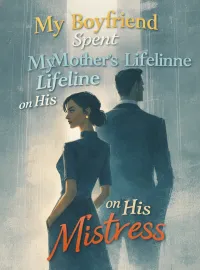
I lit the last candle at seven o'clock.
The apartment smelled like garlic and rosemary. Ryder's favorite. I'd worn the navy dress he once said made me look "impossible not to stare at." Three years ago tonight, in a wine bar on Bleecker, he'd told me I was the reason he could breathe. I still remembered the exact way he said it. Like it cost him something.
At 7:15, my phone buzzed on the counter.
**Ryder:** Babe. Emergency. Flying out to Seattle tonight — client crisis. I'm so sorry. I'll make it up to you. Swear.
I read it twice. Then a third time.
I told myself it was fine. He'd sworn a lot of things lately. I sat down at the table anyway. Poured myself a glass of the Barolo he liked. The steak got cold. The candles kept burning.
I ate half of my plate before I gave up.
Around 8:30, my phone lit up again. Not a text. An Instagram notification. Some girl from our old grad school circle had tagged Ryder in a story.
I opened it.
A rooftop bar. String lights. Manhattan skyline glittering behind two people crammed into a corner booth. Ryder was leaning in, laughing, his hand on the back of the seat behind Chandler Howell's shoulders. Her head was tipped toward his. Champagne flutes raised. The caption read: *These two 🥂*
I recognized the bar. It was twenty blocks from our apartment. Not Seattle. Not even LaGuardia.
I set the phone face-down on the table.
I didn't cry. I didn't call him. I didn't do anything for a long time. I just sat there with the candles guttering low, watching wax pool onto the wood, feeling something shift inside me — quiet, tectonic. Like a floor giving way in a house you've lived in too long to notice was rotting.
When the last flame drowned itself out, I finally stood up and blew on my fingers. They were cold.
---
Two weeks later, I was working a client event in a converted warehouse in Brooklyn.
I remember the string lights again. The way they made everything look softer than it was.
I stepped outside for air. That was all. Just air. The alley smelled like rain and dumpster steam, and a man was standing near the loading dock, muttering to himself. I didn't think anything of it. This is New York. You keep walking.
He came at me fast.
I didn't even see the knife until I was already on the ground. There was pressure, then heat, then a sound coming out of my own throat that I didn't recognize. Someone screamed. Someone else grabbed him. I remember the wet asphalt against my cheek and the string lights swaying above me like they were laughing.
I woke up in a hospital room I didn't recognize.
The doctor was a woman with kind eyes and a clipboard. She sat down on the edge of the bed before she spoke, which is how I knew.
"Ms. Ward. I need to tell you some things."
She used the word *reconstructive.* She used the word *irreversible.* She used the word *never.*
The knife had finished what the first one started, five years ago. My uterus. My ovaries. What was left of them. Gone.
"I'm so sorry," she said. She meant it. Her hand was warm on mine.
I nodded. I don't know why. I just kept nodding.
Ryder didn't come for three days.
When he finally walked in, he had a bouquet of grocery-store lilies already going brown at the edges. He kissed my forehead. He said the words *closing a deal* and *couldn't get away* and *baby, I'm here now.*
I looked at him. Really looked. The tan he shouldn't have had. The scratch on the back of his hand. The way he touched his neck when he said *Seattle,* even though I hadn't asked.
Something in me cracked. Not loud. Just final. Like a hairline fracture running through a bone you didn't know was holding you up.
"Thank you for coming," I said.
He smiled, relieved. He didn't hear it.
---
A month later, my mother started forgetting the names of streets she'd lived on for forty years.
Dr. Nora Voss at Memorial Sloan Kettering used the same careful voice the Brooklyn doctor had used. She was younger than I expected. She sat with us for a long time.
"Glioblastoma. Grade four. Aggressive."
My mother nodded like she was being told about the weather. She'd always been like that. Steel wrapped in a cardigan.
"There is," Dr. Voss said carefully, "an experimental targeted therapy. Right here at Sloan. The response rates are — genuinely promising. It could give her real time. Possibly years."
"How much?" I asked.
Dr. Voss glanced at my mother, then back at me.
"One point five million. Out of pocket. Insurance won't touch it yet."
My mother reached over and squeezed my hand. "Elia. Sweetheart. It's alright. We'll—"
"We'll get it," I said.
I didn't have it. I'd sold my father's brownstone two years ago. Every dollar was inside Ryder's company. My savings account had four figures on a good month.
That night, I sat across from Ryder at our kitchen table. I told him. I watched his face.
He took both my hands. His palms were warm and dry. His eyes locked onto mine, steady, that startup-founder gaze that had raised twelve million dollars from strangers.
"Elia. Look at me. I swear on my life. On *my life.* The money will be wired by Friday."
He didn't touch the back of his neck.
I wanted so badly to believe him that I did.