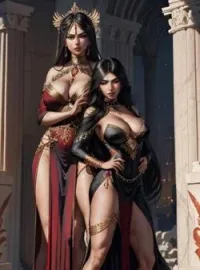
Days passed, measured not by bells or sunrises but by absence.
Kael’s departure left a hollow space in the palace that no one spoke of yet everyone felt. The corridors seemed longer, the council louder, the nights heavier. Selene ruled as she always had, with precision and restraint, yet something within her moved out of rhythm, like a clock wound too tightly.
She compensated by working harder.
From dawn until long after dusk, she sat in council, reviewed petitions, dictated letters, signed decrees. Trade routes were adjusted. Taxes recalculated. Patrols reinforced along vulnerable borders. Every decision was flawless, deliberate, unquestionable.
And still, unease lingered.
Lyra noticed it first.
Her sister’s eyes lingered too long on empty doorways. Her silences stretched where words once came easily. The crown sat straighter than ever upon Selene’s head, yet the woman beneath it felt strained, brittle with restraint.
Lyra said nothing. She had learned patience, learned that watching often revealed more than asking.
The nobles, however, were less subtle.
“They say Lord Draven commands the clans already,” murmured Lady Merrow during an afternoon gathering. “That he rides among them like one of their own.”
“They say he will return with an army,” replied Lord Veyne, swirling his wine. “Or not return at all.”
Eyes drifted toward Selene, measuring, probing.
Selene met their curiosity with calm indifference. “Rumors travel faster than riders. Let us wait for truth.”
Truth, however, had a way of arriving bloodstained.
The first message came at night, delivered by a breathless scout whose cloak was torn and boots stained with mud.
Lyra happened to be present when the man was ushered into the solar. Selene dismissed all others and listened in silence as the scout spoke.
“The Blackridge clans are divided,” he reported. “Some follow Lord Draven. Others prepare for war. A rival chieftain named Orun gathers men, claiming the queen weak for sending an outsider.”
Selene’s fingers tightened around the arm of her chair. “And Lord Draven?”
“He lives,” the scout said. “But Orun hunts him.”
Lyra felt a sharp twist in her chest that surprised her with its force.
“Leave us,” Selene said.
When the doors closed, silence pressed in.
“You sent him to be torn apart,” Lyra said quietly.
“I sent him to prevent war,” Selene replied. “He knew the risk.”
Lyra paced the room. “You gamble with lives as if they are pieces on your board.”
“And you gamble with hearts,” Selene snapped. “Which is worse?”
Lyra stopped. “Do not pretend this does not frighten you.”
Selene’s voice softened despite herself. “Fear keeps kingdoms alive.”
Lyra shook her head. “No. Fear rots them.”
That night, Lyra dreamed of fire on the northern hills and a man standing alone against it, blood on his hands, resolve in his eyes. She woke before dawn, restless and angry with herself.
By the end of the week, another message arrived, this one sealed with wax bearing Kael’s mark.
Selene broke it with steady hands.
The words were brief but heavy with consequence.
Orun had declared open defiance. The clans stood on the edge of war. Kael requested reinforcements, not soldiers, but legitimacy. A sign that he spoke with the queen’s authority.
Selene read the letter twice, then once more.
Lyra watched her face carefully. “He needs you.”
“He needs the crown,” Selene replied.
“Then go,” Lyra said without hesitation.
Selene looked at her sharply. “Go north?”
“Yes,” Lyra said. “Show them their queen is not a distant myth. Show them strength.”
Selene laughed softly, without humor. “The council would never allow it.”
“Then do not ask,” Lyra said.
The idea settled between them, dangerous and intoxicating.
That afternoon, Selene convened the council. Voices rose, objections flew, caution wrapped itself around every argument. Selene listened, waited, then silenced them with a single lifted hand.
“I will ride north,” she declared.
The chamber erupted.
“Impossible.”
“Reckless.”
“An invitation to assassination.”
Selene’s gaze was iron. “This discussion is concluded.”
When the council finally dispersed, Lyra caught up to her sister in the corridor.
“You surprise me,” Lyra said. “You rarely choose yourself.”
“I am choosing Eryndor,” Selene replied.
Lyra studied her. “And Kael?”
Selene did not answer.
Preparations were made in secrecy. Only a small retinue would accompany the queen, loyal guards sworn to silence. Officially, Selene would be inspecting border settlements. Unofficially, she was walking into the teeth of rebellion.
Lyra was not invited.
She stood in the stables as Selene mounted her horse, armor hidden beneath a traveling cloak.
“You should stay,” Selene said. “The court will need you.”
Lyra smiled faintly. “You mean they will need someone to watch them.”
“Yes.”
“And him?” Lyra asked. “Who will watch him?”
Selene met her gaze. “You will.”
Lyra laughed softly. “You trust me with a great deal.”
“I trust you with Eryndor,” Selene replied. “Do not make me regret it.”
As Selene rode out, Lyra felt the palace shift around her, the weight of responsibility settling onto her shoulders. For the first time, she was not simply the queen’s sister.
She was her shadow.
In the north, Kael moved through hostile lands with careful steps. Orun’s presence pressed in from all sides, a constant threat. When Selene arrived, her banners unfurled against the gray sky, it sent shockwaves through the clans.
The queen had come.
Kael met her outside a fortified camp, disbelief flashing across his face before he masked it.
“You should not be here,” he said.
Selene dismounted. “Neither should you.”
They stood facing each other, tension threaded with something far deeper.
Inside the camp, negotiations stretched long into the night. Selene spoke with authority that brooked no challenge. She offered alliances, protections, consequences. Some listened. Some glared.
Orun did not appear.
At dawn, violence erupted.
An ambush struck the outer perimeter, arrows screaming through mist. Chaos followed. Selene was rushed toward shelter as blades clashed and horses screamed.
Kael fought his way to her side, blood streaking his armor.
“This was a trap,” he shouted. “Orun wants your head.”
Selene drew a hidden blade. “Then he will be disappointed.”
They moved together through the chaos, instinct guiding them where words failed. For a brief, dangerous moment, they were not queen and lord, not ruler and subject.
They were survivors.
The attack was repelled, but the cost was high. Bodies littered the ground. Smoke curled into the pale morning sky.
As healers moved among the wounded, Kael found Selene standing alone, staring at the carnage.
“This is my fault,” she said quietly.
“No,” Kael replied. “This is war refusing to stay hidden.”
She turned to him. “If I die here, Lyra will inherit a kingdom already bleeding.”
Kael’s voice softened. “You will not die.”
“You cannot promise that.”
“I can fight for it,” he said.
Their eyes locked, everything unspoken rising dangerously close to the surface.
Back in Eryndor, Lyra paced the throne room alone. Reports arrived slowly, fragments carried by messengers and rumor. An ambush. Bloodshed. The queen alive, for now.
Lyra pressed her palm against the cold arm of the throne.
For the first time, fear clawed openly at her.
Not fear of losing power, not fear of chaos, but fear of losing Selene.
And beneath it, another truth stirred, unwelcome and undeniable.
She feared for Kael too.
In that moment, Lyra understood what Selene had always known.
Love did not weaken power.
It threatened to destroy it.
And the deeper it cut, the more ruthless one had to become to survive.