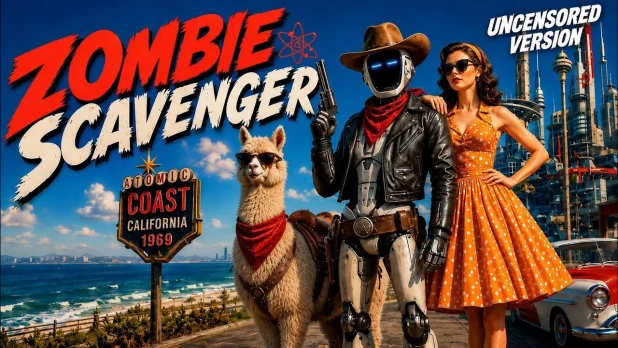
From a Vocational Student’s Laptop to Global Attention: What Zombie Scavenger Reveals About the Future of AI-Powered Short-Form Entertainment
A 3.5-minute AI film created by a Chinese student has captured millions of views online. More importantly, it highlights how the economics, talent pipeline, and creative barriers of visual storytelling are being rewritten in the age of AI.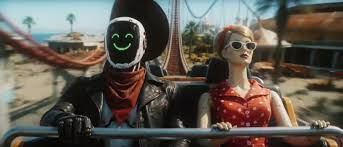 The global short-form entertainment industry is becoming accustomed to disruption.
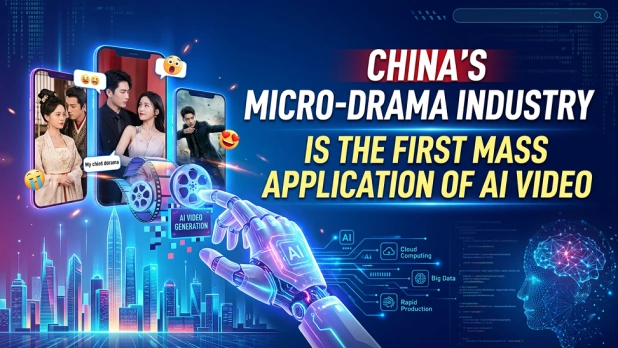
Over the past year, AI-generated vertical dramas have emerged as one of the fastest-growing segments in mobile entertainment. Chinese AI-produced titles such as The Golden Tomb Seeker and Series Tower recently earned selection in the Fantastic Pavilion screening program at the Cannes Film Festival, while AI-native short dramas have begun generating meaningful commercial traction in overseas markets.
Now another project is attracting industry attention—not because of a major studio budget or a sophisticated production pipeline, but because of who made it. Zombie Scavenger, a 3-minute-and-33-second AI-generated short film created by Chinese content creator Mx-Shell, has become a viral phenomenon across social media. According to publicly visible platform metrics referenced in the source material, the film accumulated millions of likes and widespread international discussion shortly after release.
The story behind the project may be even more remarkable than the film itself.
According to interviews cited in Chinese media reports, the creator is a vocational school student from Yunnan Province who reportedly produced the film using a consumer-grade computer, approximately ten days of work, and a budget of around RMB 3,000 (roughly US$400).
Whether or not every detail becomes part of AI filmmaking folklore, the broader significance is difficult to ignore.
A project created outside traditional film schools, studios, and production ecosystems managed to attract attention from creators, AI artists, and entertainment professionals around the world.
For the short drama and mobile entertainment industry, that may be the real story.
Not a Vertical Drama—But Highly Relevant to the Vertical Drama Business
Strictly speaking, Zombie Scavenger is not a vertical drama.
It is a short-form AI film with a runtime under four minutes.
Yet its rapid spread offers valuable insight into the same audience dynamics that increasingly drive the vertical drama economy: strong hooks, emotional clarity, highly visual storytelling, and global accessibility.
The film follows a robot cowboy with an LED-screen face who hunts zombies across a post-apocalyptic landscape.
There is almost no dialogue.
The protagonist communicates primarily through movement, visual expression, music, and situational storytelling.
Along the way, he encounters an ostrich companion, battles zombies, and unexpectedly falls in love with a store mannequin.
The premise sounds absurd on paper.
On screen, however, the execution reportedly resonated with audiences because it combines familiar genre elements with emotional sincerity.
The film draws from a broad collection of globally recognizable entertainment motifs:
- Zombies
- Western cowboys
- Robots
- Post-apocalyptic landscapes
- Road-movie aesthetics
- Romantic companionship
- Action-comedy pacing
None of these concepts require cultural translation.
That matters.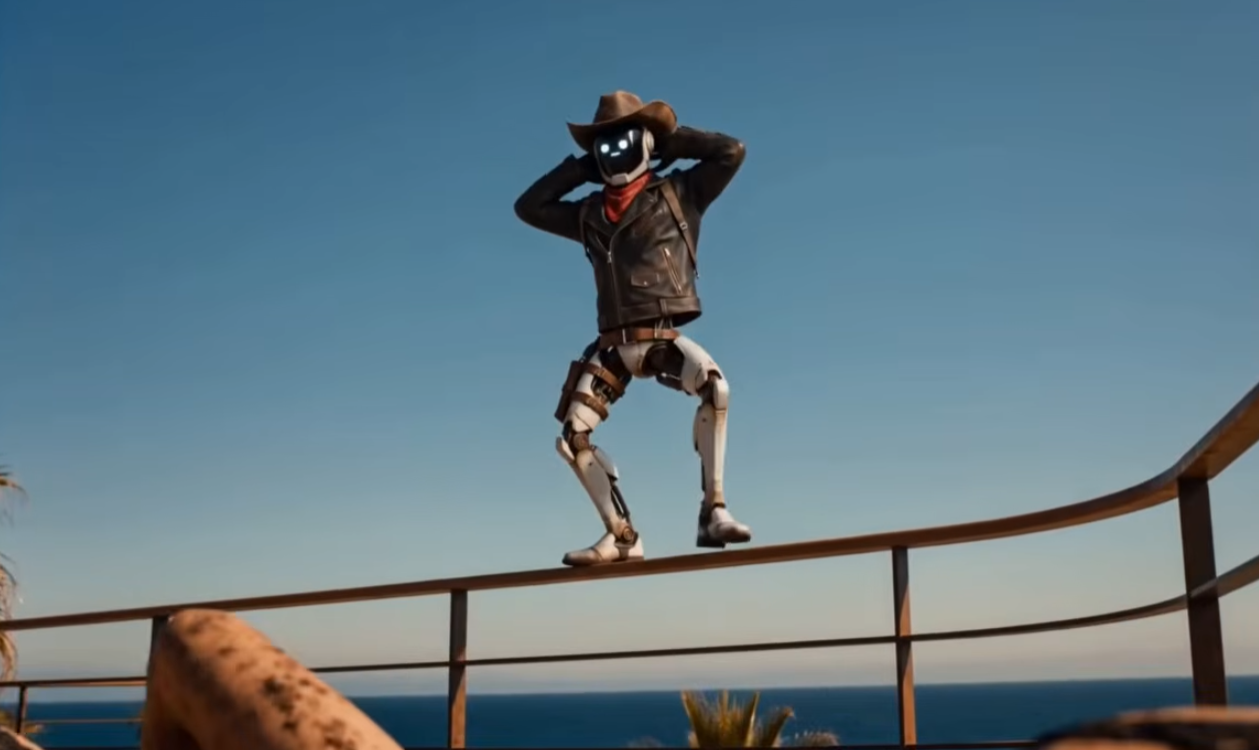 One of the biggest challenges facing international short-form content is cross-cultural accessibility. The more localized a narrative becomes, the more difficult it can be to scale globally.
Zombie Scavenger takes the opposite approach.
Its storytelling language is essentially universal.
A robot seeking connection in a broken world is a premise audiences from Los Angeles to London, Seoul to São Paulo, can understand immediately.
Why Hollywood Creatives Took Notice
The industry conversation surrounding Zombie Scavenger has focused less on AI technology itself and more on the project's surprisingly mature storytelling instincts.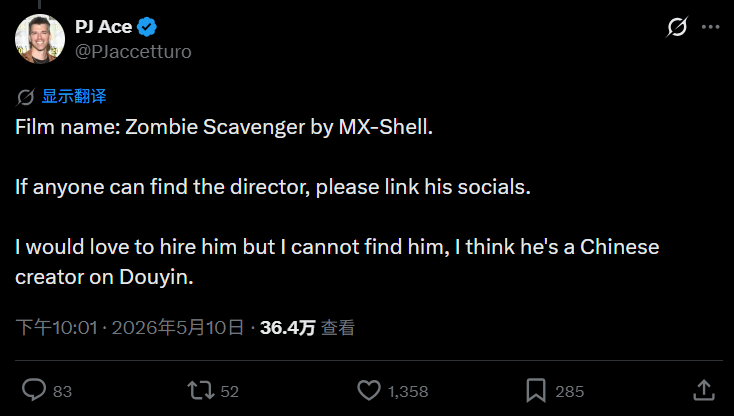 Many AI-generated videos successfully demonstrate technical capabilities.
Far fewer demonstrate narrative control.
The film's structure reportedly follows a familiar but effective emotional progression:
- Introduce an entertaining protagonist
- Establish a dangerous world
- Create visual spectacle
- Shift unexpectedly into romance
- Build emotional attachment
- Deliver narrative payoff
The transition from zombie action film to surprisingly heartfelt love story appears to be one of the reasons viewers responded so strongly.
Rather than centering survival, military conflict, or world-ending stakes, the story focuses on companionship.
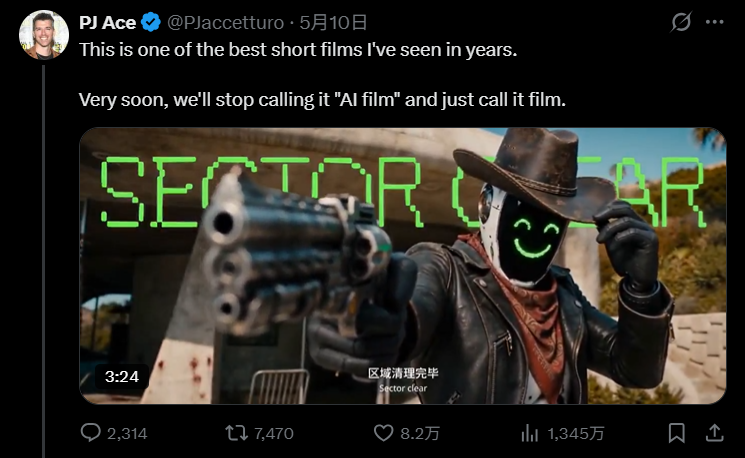
The robot cowboy's relationship with a mannequin transforms what initially appears to be a genre parody into something closer to an emotional character story.
Industry observers have compared elements of the project to classic animated features such as the movie WALL·E, which similarly explored loneliness, connection, and humanity through non-human protagonists. The comparison is not about production scale.
It is about emotional universality.
In an AI content ecosystem increasingly flooded with technical demonstrations, projects that successfully create emotional engagement are becoming more valuable than projects that merely showcase visual effects.
The Democratization of Visual Storytelling
Perhaps the most important industry takeaway is what Zombie Scavenger reveals about talent development in the AI era.
Historically, producing cinematic visual content required access to:
- Expensive cameras
- Large crews
- Professional VFX pipelines
- Specialized education
- Industry connections
- Significant financial resources
Those barriers served as gatekeepers for decades.
AI tools are rapidly changing that equation.
According to the creator's own comments reported by media outlets, the production process behind Zombie Scavenger differed significantly from traditional workflows.
The creator reportedly relied less on detailed scripts, extensive storyboards, or highly structured generation pipelines than many professional AI production teams currently advocate.
While such an approach may not be suitable for large-scale commercial productions, the project's success highlights a broader trend:
Creative intuition is becoming increasingly important relative to technical resources.
As generative tools improve, the competitive advantage shifts away from who can access production technology and toward who can use it to tell compelling stories.
For short drama platforms, this shift carries significant implications.
The next breakout creator may not emerge from Hollywood, television networks, or established film schools.
They may emerge directly from online creator communities.
AI Is Compressing the Creator Learning Curve
Another notable aspect of the story is the reported speed of development.
According to publicly available interviews, Mx-Shell only began experimenting seriously with AI video tools earlier this year.
Within months, the creator progressed from small-scale experiments to producing a globally discussed AI film.
This type of accelerated learning curve is becoming increasingly common across AI creative industries.
Historically, mastering visual storytelling required years of technical training.
Today, AI systems handle much of the execution burden that previously demanded specialized expertise.
That does not eliminate the need for creativity.
Instead, it changes where creative value is created.
The most successful AI creators increasingly resemble directors, editors, and storytellers rather than technicians.
The ability to generate images is becoming commoditized.
The ability to generate audience emotion remains scarce.
Two Paths Emerging in AI Entertainment
Looking across the current AI entertainment landscape, two distinct development paths are becoming visible.
Path One: Industrialized AI Storytelling
Projects such as The Golden Tomb Seeker and Series Tower represent the industrialization of AI production.
These productions involve:
- Established intellectual property
- Professional writers
- Structured development pipelines
- Long-term franchise planning
- Multi-stage production workflows
Their recent recognition at Cannes demonstrates growing institutional acceptance of AI-assisted storytelling.
Path Two: Creator-Led AI Filmmaking
Projects such as Zombie Scavenger represent something different.
They demonstrate how individual creators can leverage AI tools to produce globally competitive visual storytelling without traditional industry infrastructure.
This creator-led model resembles the early evolution of YouTube, TikTok, and independent gaming.
A single creator can now achieve a level of visual sophistication that would have been inaccessible only a few years ago.
For platforms, studios, and investors, both models matter.
One scales through infrastructure.
The other scales through talent discovery.
What This Means for the Short Drama Industry
For executives operating in the global vertical drama market, Zombie Scavenger should be viewed as more than a viral AI film.
It is evidence that audience expectations are evolving.
Consumers increasingly care less about whether content is AI-generated and more about whether it is entertaining.
That shift mirrors the broader trajectory of computer-generated imagery.
CGI was once a novelty.
Today it is simply part of filmmaking.
Many industry leaders expect AI to follow a similar path.
As one AI creator executive recently suggested, the industry may eventually stop referring to works as "AI films" altogether.
They will simply be films.
The same may ultimately be true for AI-generated short dramas.
The winners will not necessarily be the companies with the most advanced models.
They will be the creators and platforms that best understand storytelling, emotional resonance, and audience psychology.
Industry Takeaways
- Zombie Scavenger demonstrates the growing ability of independent creators to produce globally competitive AI-generated content.
- Cross-cultural storytelling remains one of the most valuable assets in international short-form entertainment.
- Emotional engagement is increasingly becoming a stronger differentiator than technical AI capabilities.
- AI is accelerating talent development and lowering barriers to visual content creation.
- The AI entertainment market is evolving along two parallel tracks: industrial-scale production and creator-led innovation.
- For short drama platforms, creator discovery may become as important as technology investment.
Related Recommendations


Popular Articles