Hollywood’s Vertical Pivot: How Disney, Google, and $250M ‘Drama Factories’ are Reimagining the Future of Cinema in 2026
The global entertainment landscape has officially hit a critical inflection point. Recent mobile data reveals a staggering shift in consumer behavior: the daily viewing time of short drama apps on mobile devices has now officially surpassed that of the world’s largest traditional streaming platforms.
What began as an experimental market defined by fast-paced, low-budget "guilty pleasure" tropes has institutionalized. In the opening months of 2026, tech titans, legacy Hollywood studios, and Academy-level international directors are fully mobilizing into the vertical video ecosystem, triggering a massive wave of premiumization and infrastructure spending.
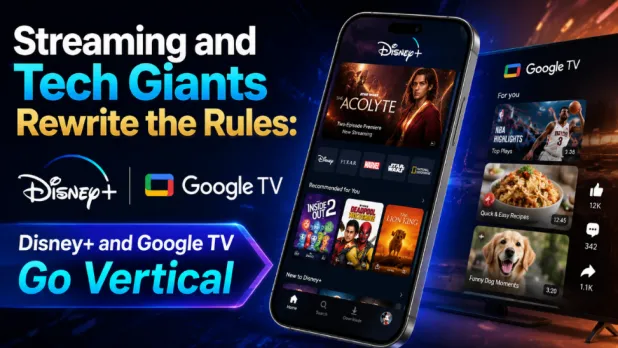
1. Streaming and Tech Giants Rewrite the Rules: Disney+ and Google TV Go Vertical
In March 2026, entertainment and technology heavyweights made back-to-back structural commitments to vertical short-form content.
Disney+ Launches "Verts"
The Walt Disney Company officially introduced "Verts," a dedicated vertical video interface integrated into the US Disney+ mobile application. Similar to social feeds, users can swipe vertically through curated, high-impact clips from Disney’s extensive library. If a clip catches their attention, they can instantly jump to the full-length feature or add it to their watchlist.
Disney executives view Verts as a multi-layered ecosystem gateway. Following a trial run with its "Vertical Shorts" pilot series Locker Diaries—which utilized legacy IPs like Zombies and Phineas and Ferb—the company plans to open the feature to fan creators. This includes bringing selected user-generated content powered by OpenAI’s Sora directly onto the Disney+ platform. According to top Disney leadership, vertical video serves as an immersive lever to deepen fan culture and complement core traditional content.
Google’s "100 Zeros" Ecosystem
Simultaneously, Google finalized a massive joint venture with prominent Hollywood talent agency Range Media Partners under the "100 Zeros" banner. The partnership is slated to produce dozens of vertical scripted and unscripted series optimized exclusively for mobile screens.
To ensure friction-free consumption, Google TV’s mobile application has launched a dedicated micro-drama hub in the US market, giving users priority access to these premium series. The initiative cleverly bridges content with utility, using premium narrative storytelling to subtly showcase Google’s proprietary hardware and software ecosystems.
2. The A-List Invasion: Hollywood and Box-Office Veterans Take the Reins
The "couch-to-phone" migration has caught the eye of elite narrative filmmakers who are rapidly moving past the cliché writing styles of early short-form apps.
Hollywood Heavyweights Sign On
Google and Range Media's "100 Zeros" lineup features a striking list of mainstream entertainment pioneers, including:
● Simon Fuller (Creator of American Idol)
● Mike Fleiss (Creator of The Bachelor)
● McG (Director of Charlie’s Angels and Executive Producer of Baywatch)
Concurrently, horror cinema veteran Charles Band teamed up with breakout short-drama stars (including Love Fan Awards winner Guilmette and noted antagonist actor Moliski) to form FMA Productions. This specialized vertical label is pioneering a "dual-format" distribution strategy—shooting native vertical series for specialized apps like ReelShort, while compiling alternative horizontal cuts for platforms like Prime Video and Tubi.
South Korea’s "Thousand-Box-Office" Migration
In Asia, South Korea’s world-renowned TV and film infrastructure is pivoting aggressively toward short-form. The country's micro-drama market has seen an explosive platform growth rate of 324%.
● Director Lee Joon-ik (The legendary mind behind the historical masterpiece The King and the Clown) is currently developing a vertical adaptation of the popular Lezhin webtoon Dad’s Rice, drawing interest from top-tier actors like Lee Jung-eun (Parasite) and Byun Yo-han (Mr. Sunshine).
● Director Lee Byeong-heon (Director of Korea’s all-time box office champion Extreme Job) debuted his 47-episode vertical series My Kid’s Dad is My Friend via Lezhin Snack this February, immediately dominating the daily charts.
Major gaming and media conglomerates are funding this pipeline. Krafton (the creator of PUBG) injected 120 billion KRW into short-drama platform Vigloo, which produced 200 original series in 2025 and plans to double its output to 400 in 2026. According to Vigloo’s internal analytics, 70% of their revenue is generated from global overseas markets, with women over the age of 35 making up 70% of their core audience.
3. Industrialization: Inside the $250M "Drama Factories" and Global Subsidies
As production values rise, the physical infrastructure of filmmaking is adapting to keep pace with the hyper-accelerated timelines of vertical media.
| Region / City | Infrastructure & Policy Commitments | Strategic Advantage |
| Los Angeles, CA | Approved a $5 million micro-drama subsidy (14-0 unanimous City Council vote). Features a 3-day expedited permit approval window and a 40% tax rebate for projects budgeted under $200,000. | Lowers barriers to entry for domestic and international crews looking to source premium Hollywood actors and creative talent. |
| Paterson, NJ | Construction underway for Filmology Labs, a massive $250 million, 250,000 sq. ft. studio complex founded by E! Entertainment Television co-founder Alan Mruvka. | Features 21 pre-built, pre-lit virtual stages, advanced LED Volume Walls, and AI integration. Serves as the high-output hub for VERZA TV, targeting a minimum output of 2+ short dramas per month. |
| Paju, South Korea | Development of modular "four-sided architectural" filming hubs located north of Seoul. | A single villa structure is engineered with four distinct exterior facades (European mansion, old洋房, Mediterranean resort, modern townhouse) to allow rapid multi-genre shooting without changing locations. |
Summary: The Next Frontier of Global Entertainment
The events of early 2026 confirm that vertical short dramas are no longer a passing internet trend or a localized phenomenon. Backed by multi-million dollar institutional subsidies, elite Hollywood showrunners, and cutting-edge virtual studio tech, the medium has evolved into a highly competitive global economy.
As the lines between legacy streaming, AI-driven tech, and mobile narratives completely blur, the future of global cinema belongs to those who can capture native human emotion—one vertical frame at a time.
Related Recommendations

Popular Articles